Katy Faust says we can, we must, reclaim marriage
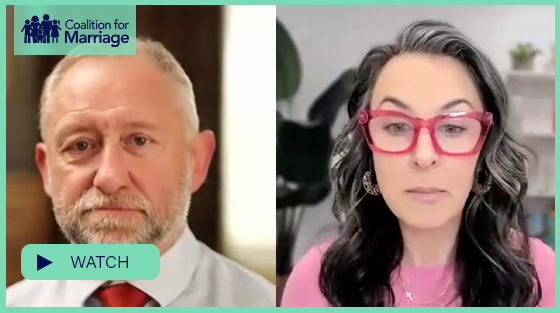
On Wednesday, the Church in Wales Governing Body voted to make blessings for same-sex civil unions a permanent feature of Welsh church life. The Bill passed in each of the three Orders: bishops unanimous, clergy 32 to 7 with 5 abstentions, laity 48 to 8 with 2 abstentions. A further vote is expected in 2027 on solemnising such unions as marriages in Welsh churches. I want to share a conversation I had recently with Katy Faust on where this road leads. Katy founded Them Before Us in 2017 and has launched the Greater Than alliance, a movement of about a hundred organisations and individuals seeking to roll back same-sex marriage in the US. Watch the full interview.
Greater Than, she says, is “the first attempt in any country to retake marriage on behalf of children” after the term was redefined in national law. The argument is not anti-gay. Civil partnership already confers equal legal rights. What the redefinition of marriage broke was something different: the link, in law, between a child and the biological mother and father who gave them life. Faust puts it plainly: “If you believe in gay marriage, mothers and fathers are optional in the life of a child. If you believe children have a right to their mother and father… you cannot support gay marriage as policy.”
None of this is only an American question. The UK adoption sector is pushing to recruit same-sex couples to fill a shortage, and the Government’s Renewing Fostering action plan treats marriage as an outdated barrier. Faust is blunt. “Adoption doesn’t exist for adults. This is not some vehicle to have a DEI win on the registry.” As an adoptive mother, she says her son needed the different attributes of both a mother and a father – nurture and affection from her, and firm boundaries and encouragement to take risks from her husband.
The deeper question, she argues, is how parenthood itself is defined. Parenthood should be “recognised, not assigned”, she says. When biology does not matter, children “are now objects to be assigned to any adult”. Her colleague Josh Wood put it recently in The Federalist: “If ‘sex assigned at birth’ strikes you as Orwellian, ‘parent assigned at birth’ should terrify you.”
And once the State can assign parents, it can unassign them too. Justice Minister Baroness Levitt KC’s statement that “being a parent is a privilege not a right” now sits behind Clause 17 of the Courts and Tribunals Bill. “If the state has the ability to assign parentage to an unrelated adult”, Faust says, “they have much more the ability to unassign parentage from you, from your own relationship with your own child”.
The US Government has gone the other way. Its national security strategy, published last November, states plainly that “growing numbers of strong, traditional families that raise healthy children” is vital to the nation’s flourishing. A major US policy report in January, Saving America by Saving the Family, calls marriage “the committed union of one man and one woman” and “the cornerstone” of civilisation. Italy holds a similar position. The current UK Government has no equivalent language in its planning.
Marriage is the word for what only a man and a woman can do: bring a child into being and commit to raise that child for life. Every redefinition weakens the child's claim on the parents who gave them life.