Poland under heavy fire from anti-marriage forces
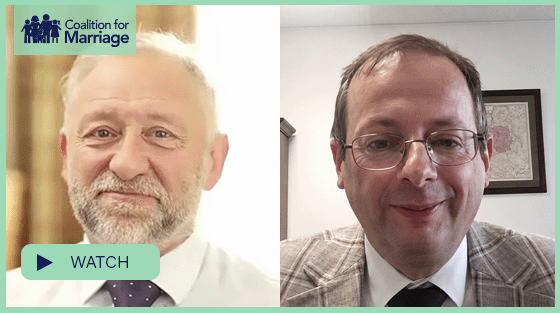
Poland is now the front line in Europe’s battle for marriage as the lifelong union of one man and one woman. The President is holding the line. But the forces against it are marshalling – in EU court rulings, in Sejm committee rooms, in a Prime Minister’s apology. How long can real marriage survive there? This week, I sat down again with Olivier Bault of the Ordo Iuris Institute for Legal Culture in Warsaw. Watch our conversation here.
On 30 April 2026, President Karol Nawrocki vetoed the Tusk government’s ‘express divorce’ Bill. “A Las Vegas-style marriage – quickly entered into and easy to end – may be a cinematic scene,” he said, but: “In a serious state, laws and statutes are not the writing of a film script.” The Bill would have let couples without children dissolve a marriage at a civil registry desk. No court. No reflection. It would have transformed marriage, Olivier says, “into entering a trial period where the actual commitment would come about only with the first child”.
The pressure has been building for months. The EU’s top court had ordered Poland to recognise foreign same-sex marriages contracted in other EU states. The Tusk government approved a ‘cohabitation agreement’ Bill that extends partnership recognition to same-sex couples. Then the dam broke. On 7 May, days before our interview, Poland’s Supreme Administrative Court forced three more civil registries to transcribe foreign same-sex marriages. On 12 May, Prime Minister Donald Tusk apologised to same-sex couples “who, for many, many years, felt rejected and humiliated” by Poland’s refusal to recognise their relationships. “For many years”, he continued, “the state has failed the test”.
Why fight so hard over a few same-sex marriages? Because the legal logic is one-way. Every child has a biological mother and a biological father, and no same-sex couple can be both. Recognise their ‘marriage’ in law as equal to a man-and-woman marriage, and the State must rewrite who a parent is. Poland’s Digital Affairs Ministry has already proposed replacing the civil registry’s man-and-woman marriage categories with “first spouse” and “second spouse”. Marriage is what ties a child to their biological mother and father. Redefine it, and the state – not biology, not the vows of the parents – decides who a child’s parents are. “Families are the stronghold of our liberties”, Olivier says. “It is a lot harder for state authorities to have control over citizens when you have strong families.”
Poland’s defence rests on one constitutional sentence and one office. Article 18 places marriage, family, motherhood and parenthood under the protection of the Republic as the union of a man and a woman. President Nawrocki uses that sentence and his veto to hold the line. The last attempt to override one of his vetoes got 244 votes in favour, 180 against – short of the three-fifths threshold the Constitution requires.
Britain had no Article 18. No veto-wielding President. Parliament alone redefined marriage in 2013. Real marriage is the lifelong union of one man and one woman – the gold standard for children and for the nation. At C4M, we exist to put it back at the centre of British policy because standing for real marriage means standing up for everyone’s freedom. Please consider forwarding this email to a friend to raise awareness about our work.