Marriage on the Ballot again at July’s CofE Synod
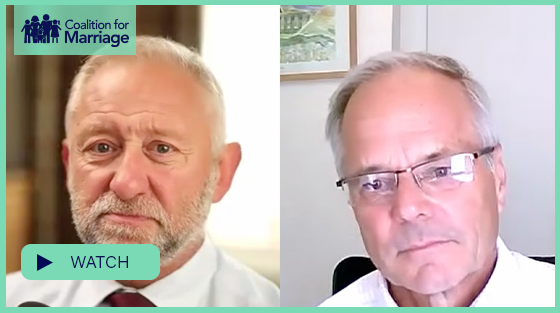
On Monday 13 July, the Church of England’s General Synod, meeting in York, will be asked to affirm that there are “no fundamental objections to being in a committed, faithful, intimate same-sex relationship”, and that such a relationship “can be entirely compatible with Christian discipleship”. The motion’s paper insists it is not about marriage. But it is – one more attempt to loosen the definition C4M exists to defend: marriage as the lifelong union of one man and one woman, the gold standard for children and for society. The Reverend John Dunnett, who leads the Church of England Evangelical Council, has spent years holding that line, and sat down with me to explain what is at stake. His full interview is on our YouTube channel.
How can we be sure it is about marriage? Because the paper gives itself away, three times. First, its key word: “intimate”. The Church still teaches that sexual intimacy belongs within marriage – one man and one woman – and nowhere else. The motion never says “sexual” – yet the paper admits it includes “a range of types of physical contact”. The ambiguities, Dunnett says, are “intentional”. Second, by the paper’s own account, its central phrase – “no fundamental objections” – echoes the 1975 vote that “began the process” towards women priests and bishops: a “simple point of principle” designed to start a chain, not to settle one. Third, it admits that passing it could challenge the bar keeping clergy in same-sex civil marriages out of ordination. Grant the principle, and same-sex marriage in the Church is the next stop on the line. The Church’s own law still defines marriage as “of one man with one woman”. This motion is the next attack against it.
Dunnett is careful about tone, and so should we be. “Everybody is welcome in our churches”, he says, pointing to the example of Christ. “At the same time, Jesus never lost sight of things that he felt were God-given.” The definition of marriage is one of them: “For 2,000 years, the Church in every culture, every century, in every continent, has believed that marriage is a wonderful gift of God... it’s two people, not three people. And it’s a man and a woman”.
The question is not who is welcome, but what marriage is for – and whom it protects. Redefine it, and you sever the biological connection between a child and the mother and father who made her. Some husbands and wives cannot have children; that is a difficulty of circumstance. No ‘same-sex marriage’ can create a child; that is categorical. When parenthood is severed from real marriage, it becomes a category the law assigns – and a child’s right to her own mother and father gives way to adult claims. Same-sex couples already gained legal rights through civil partnerships. What redefinition took was the child’s rights. Enough episodes of Long Lost Families, Dunnett says, tell the same story: “There is a profound link between an individual and his or her mother and father that can never be substituted.” He is quick to add that adoptive and single parents “can do a fantastic job” – the point is not a verdict on any family, but what marriage alone is built to protect.
At Coalition for Marriage we reach the same conclusion by a different road. We argue not from the Bible but from the evidence – and, as I put it to John, “wherever possible, a child growing up with their biological mother and father” is what gives the next generation the best start. Two roads; one destination.
Will the vote change doctrine? Not on its own - the motion, as Dunnett puts it, “has no legal value, but in PR value it could be enormously important” to those pressing for change. The institutions may wobble, but the case for marriage – one man, one woman, the gold standard – has not changed, and neither have we. Please watch John’s interview, and send it to someone who has been told this argument is lost. There is still everything to play for.